Buying guide
Bigger window, same punch: what diode laser spot size actually does for your clinic
A bigger diode window saves treatment time only when peak power scales with it. Compare handpieces on two numbers: area per pulse in cm², and power density in W/cm² across that area.
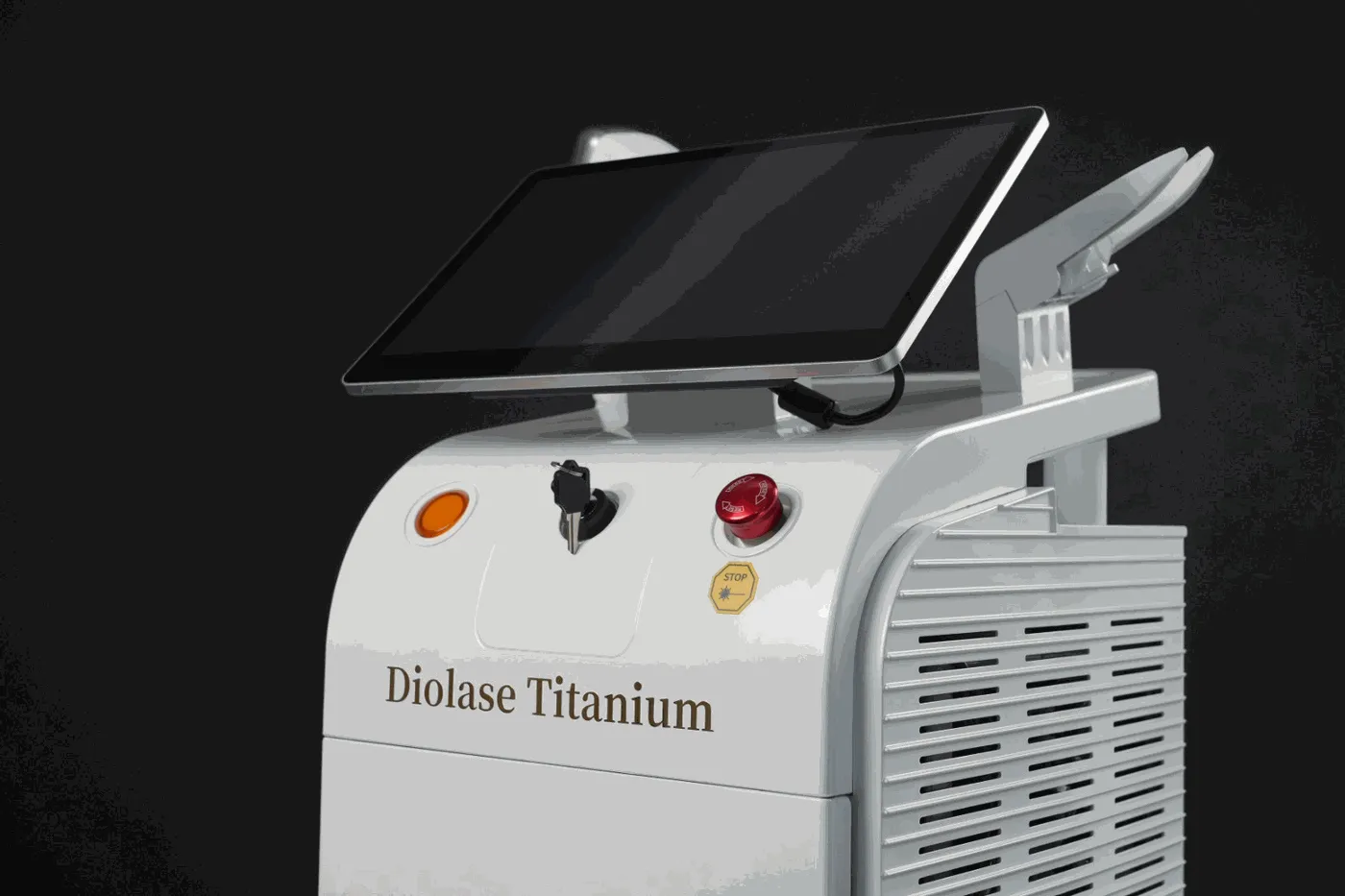
Every diode laser brochure quotes a handpiece size. Few explain what the number means for a full-body appointment, or what a large spot gives up if the power behind it doesn’t keep up. Here is how to read the spec before you buy.
Does a bigger diode laser spot size mean faster treatments?
Only when power keeps up. A larger window covers more skin per pulse, so legs and back need fewer pulses per pass. But if peak power doesn’t rise with window area, fluence per square centimetre drops and the clinician slows down to compensate. Compare handpieces on area in cm² and power density in W/cm², not window size alone.
Why spot size matters
Light entering skin scatters. Near the edge of a small beam, much of that scattered light escapes sideways and never reaches the follicle. A larger beam loses proportionally less at its edges, so more of the energy at the surface reaches the depth where the hair bulb sits.
That has two practical effects. Coarse, deep-rooted hair on the back, legs and underarms can be reached more consistently. And each pulse covers more skin, so the handpiece makes fewer passes to cover the same body area.
Do the area math
Rectangular handpieces are easy to compare once you convert them to area.
| Handpiece window | Area per pulse | vs 15 mm round |
|---|---|---|
| 15 mm round | 1.77 cm² | — |
| 12 × 24 mm | 2.88 cm² | 1.6× |
| 12 × 36 mm (DioLase Titanium) | 4.32 cm² | 2.4× |
A 12 × 36 mm window covers 50% more skin per pulse than a 12 × 24 mm window. On large areas such as legs and back, that means a third fewer pulses for every pass of the handpiece, which adds up quickly over a multi-pass session.
Spot size is only half the spec
A bigger window spreads the same energy over more skin. If the power behind it doesn’t scale up, fluence per square centimetre drops, and the clinician has to slow down or stack pulses to compensate. The time saved on paper is lost in the treatment room.
The number to check is power density: peak power divided by window area.
| Configuration | Peak power | Window | Power density |
|---|---|---|---|
| 1,200 W with 12 × 24 mm | 1,200 W | 2.88 cm² | ~417 W/cm² |
| DioLase Titanium, 1,800 W with 12 × 36 mm | 1,800 W | 4.32 cm² | ~417 W/cm² |
DioLase Titanium brings 50% more power to the handpiece: 1,800 W against 1,200 W. It puts that extra power to work across a 50% larger window, so every pulse covers half again as much skin at full intensity. The extra power is what makes the larger window useful rather than just bigger.
Three more things that decide real-world speed
- Cooling. Clinicians can only move at full parameters if the epidermis stays protected and the patient stays comfortable. DioLase Titanium uses -35°C ICE sapphire contact cooling. Our guide on how laser cooling shows up in cost per treatment covers why this matters to margins.
- Wavelength range. A fast handpiece is only fast for the patients it can treat. Quattro 4D™ keeps 808 nm at the core and adds 755 nm and 1064 nm, supporting Fitzpatrick skin types I–VI. See 755, 808 or 1064 nm: what the wavelength changes.
- Small-area access. A large window is awkward on the upper lip, nose and ears. DioLase Titanium adds a detachable precision tip, so one handpiece handles both legs and lip without slowing the session down.
TruePulse™ collimated beam delivery directs up to 99% of beam density to target tissue, which supports consistent energy across that larger window.
What faster coverage is worth
Treatment speed is a revenue lever because laser hair removal is booked by the chair-hour. Minutes saved on large areas become extra appointments, or the same schedule with less pressure on staff.
Run it for your own clinic: minutes saved per large-area appointment × large-area appointments per week = chair time recovered each week. For example, 10 minutes saved across 15 appointments a week is 2.5 chair-hours. That’s an illustration, not a forecast. The DioLase Titanium ROI calculator runs the numbers with your own pricing and volume.
Five questions to ask any diode laser vendor
- What is the window size of the main handpiece, in millimetres and in cm²?
- What is peak power, and what does that give you in W/cm² across that window?
- How is the window cooled, and to what temperature?
- Which wavelengths are available, and which skin types is the platform licensed and trained for?
- How are small areas such as the lip, nose and ears handled?
A vendor who answers all five clearly is selling a platform. One who only quotes the handpiece size is selling a brochure.
DioLase Titanium at a glance
- 12 × 36 mm main handpiece with a detachable precision tip
- 1,800 W diode platform with TruePulse™ collimated beam delivery
- Quattro 4D™ 755 / 808 / 1064 nm, with 808 nm at the core
- -35°C ICE sapphire contact cooling
- Full-body treatments in approximately 25–30 minutes, where appropriate, with a typical course of approximately 4–5 sessions depending on patient factors
- Health Canada licensed (MDL 111503) and FDA cleared
- Lease-to-own from $599/month OAC, with training through Pro 1 Laser
See what DioLase Titanium could mean for your chair time. Run the ROI calculator or request pricing.
Treatment times, session counts and outcomes vary with patient selection, provider training and protocol. Financing is on approved credit.
FAQs
How do I compare diode laser handpieces of different shapes?
Convert each window to area. A 15 mm round window covers 1.77 cm² per pulse, a 12 × 24 mm window 2.88 cm², and a 12 × 36 mm window 4.32 cm², about 2.4 times the round one. Area per pulse is what sets how many pulses a large body area takes.
What is power density on a diode laser?
Peak power divided by window area, in W/cm². It tells you whether a larger window still delivers full intensity. DioLase Titanium puts 1,800 W across a 4.32 cm² window, roughly 417 W/cm², matching a 1,200 W system on a window a third smaller.
Can a large-window diode handpiece treat the lip, nose and ears?
Only if the platform has a way to reach small areas. DioLase Titanium adds a detachable precision tip, so the same handpiece covers legs and back and then the upper lip, nose and ears without a change of equipment.
Keep reading
Considering a platform for your clinic? Request pricing or book a demo.