Buying guide
Acne scars are a service line, not a single treatment: building it with fractional CO₂
Fractional CO₂ is the backbone of most acne-scar programs: it drives collagen remodelling for months after each session. Clinics get the most from it by matching the plan to scar type and selling it as a course.
Acne scarring brings in some of the most motivated patients a clinic will see. They have usually tried topicals, peels and microneedling already, and they are ready to commit to a course of treatment. Fractional CO₂ is the tool most clinics reach for when those options have run out. Here is what clinicians and owners should know before building the service around it.
Does fractional CO₂ work for acne scars?
For most atrophic acne scars, yes, as the backbone of a planned course. Fractional CO₂ creates microscopic treatment columns that drive collagen remodelling for months, gradually lifting rolling and boxcar scars toward the surrounding skin. Icepick scars respond less and are usually combined with focal techniques. In one 2023 study, 96% of 104 patients improved after four sessions.
Know the scar before you choose the tool
Atrophic acne scars come in three main shapes, and most patients have a mix.
| Scar type | What it looks like | How fractional CO₂ fits |
|---|---|---|
| Rolling | Broad, soft depressions with sloping edges | Responds well, often paired with subcision to release tethering |
| Boxcar | Wider depressions with sharp vertical edges | Good candidate; deeper passes help soften the edges |
| Icepick | Narrow, deep pits | Hardest to treat with any resurfacing; often combined with focal techniques |
Because scar types coexist, a protocol built around one modality alone tends to under-deliver. Plan for fractional CO₂ as the backbone of a course, not the only step.
Why fractional CO₂ is the backbone
A fractional CO₂ laser at 10,600 nm ablates thousands of microscopic columns of tissue while leaving the skin between them intact. Those columns trigger a wound-healing response that remodels collagen for months after each session, which is what gradually lifts depressed scars toward the surrounding skin. The untouched bridges between columns are why healing is faster than with fully ablative resurfacing.
The published evidence is consistent with what clinicians see. In one 2023 study of 104 patients with Fitzpatrick III–IV skin, 96% improved, most by one or two scar grades, after four sessions at six-week intervals (Bhat et al., Journal of Cutaneous and Aesthetic Surgery). Results in any one practice depend on patient selection, protocol and technique.
Protocol considerations
These are the decisions that separate a reliable acne-scar service from inconsistent results. Final parameters always come from training and the device’s approved protocols.
- Patient selection. Active acne should be controlled first. Recent isotretinoin use, a history of keloids or poor healing, and active infection all call for caution or delay. Fitzpatrick type should shape density and aftercare from the first session.
- Depth and density. Scar revision usually calls for deeper columns at moderate density, with lighter passes to blend edges into untreated skin. A scanner that lets you vary pattern, size and density per area is what makes this practical.
- Course, not a single visit. Plan a series. Collagen remodelling continues for months after each session, so results build over the course and keep improving after the last one.
- Combination approaches. Subcision for tethered rolling scars and focal techniques for icepick scars pair naturally with fractional CO₂. Sell the course as a plan, not a menu of separate procedures.
- Downtime and aftercare. Patients should expect several days of redness, swelling and peeling. In the 2023 study above, transient redness and crusting settled within two to three weeks, and post-inflammatory hyperpigmentation in 12% of patients resolved within six to eight weeks. Pre- and post-care protocols, especially sun protection, matter more in darker skin types.
Setting expectations clearly at consultation is the best retention tool you have. Patients who know a course takes months stay for the whole course.
Building the service line
Acne-scar revision is sold as a course, which makes it one of the most predictable revenue streams on a CO₂ platform. As an illustration, a four-session course at a sample price of $700 per session is $2,800 per patient, booked months in advance. Your pricing will vary by market and by combined procedures.
The same platform then covers resurfacing for photoaging, lines and texture, which keeps the device busy between scar courses. Utilization, not the number of indications on a brochure, is what drives return on the equipment.
What to look for in a CO₂ platform for scar work
- Scanner control. You need to vary pattern, size and density per area. Wavelength is 10,600 nm on every CO₂ laser, so the scanner is where platforms actually differ.
- Power headroom. More available power lets you reach scar depth at practical speeds without overworking the device.
- Training and protocols. Scar revision rewards technique. Clinical training at installation, and support afterwards, shortens the learning curve.
- Warranty and service. A CO₂ laser that is down is a course of patients rescheduled. Check warranty length and who services the device.
- Range beyond acne scars. Every additional indication the device supports is more hours it earns.
Alexa CO₂ for acne-scar revision
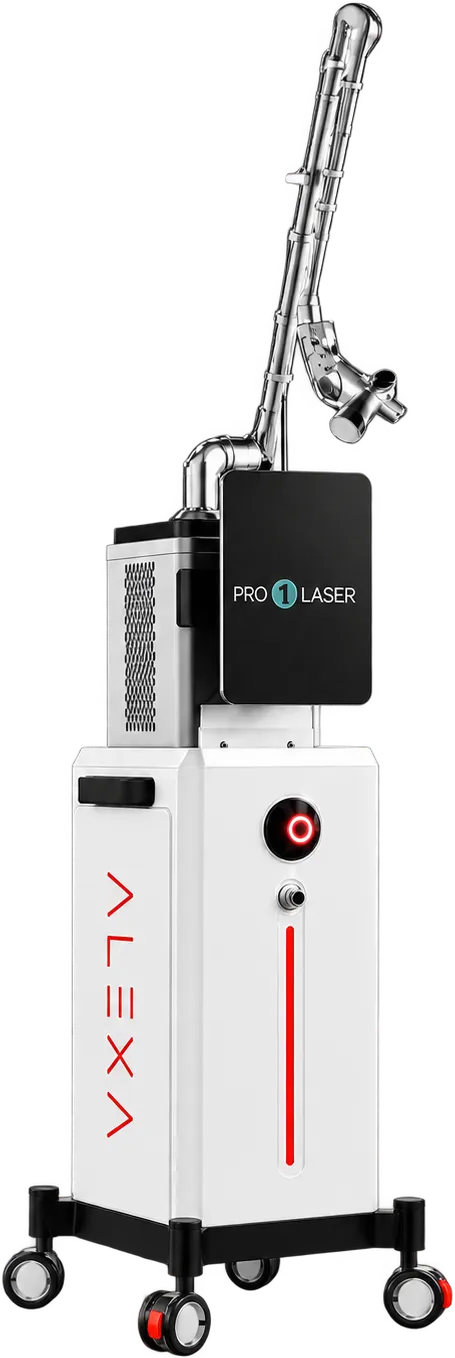
Alexa CO₂ Aesthetic is built for both the repeatable fractional tier and corrective ablative work.
- 10,600 nm CO₂ with articulated-arm beam delivery
- 40 W (Alexa Aesthetic) or 60 W (Alexa Pro MVP 7)
- Fractional scanning up to a 30 mm treatment area
- Indicated for acne and surgical scar revision, fractional and ablative resurfacing, and benign lesion removal
- Alexa Femme™ women’s-health protocols available as a separate service line
- Clinical training, onboarding and ongoing support, plus an 18-month warranty and free standard shipping within Canada
- Health Canada licensed (MDL 114909), sold manufacturer-direct
- Lease-to-own from $799/month OAC
See how Alexa CO₂ fits an acne-scar program in your clinic. Book a demo or request pricing. For the difference between fractional and fully ablative work, read Ablative or fractional? The CO₂ distinction.
Clinical results vary with patient selection, provider training and protocol. Indications and regulatory availability may vary by jurisdiction. Financing is on approved credit.
FAQs
Which acne scars respond best to fractional CO₂?
Rolling and boxcar scars are the strongest candidates. Rolling scars often respond best when paired with subcision to release tethering, and deeper passes help soften boxcar edges. Narrow, deep icepick scars are the hardest to treat with any resurfacing and are usually combined with focal techniques.
How many fractional CO₂ sessions does acne-scar revision take?
It is planned as a series rather than a single visit, with the final plan set by training and the device's approved protocols. In the 2023 study by Bhat et al., patients received four sessions at six-week intervals, and 96% improved.
How much downtime should patients expect?
Several days of redness, swelling and peeling is typical. In the 2023 study, transient redness and crusting settled within two to three weeks. Clear expectations at consultation, plus pre- and post-care with sun protection, keep patients on the course.
What makes one CO₂ laser better than another for scar work?
Every CO₂ laser runs at 10,600 nm, so the differences are in the scanner, the available power, and the training and service behind the device. Scar work needs a scanner that varies pattern, size and density per area, and enough power to reach scar depth at practical speeds.
Keep reading
Considering a platform for your clinic? Request pricing or book a demo.