Comparison Guides
ATHENA Super ICE vs DioLase Titanium
ATHENA Super ICE and DioLase Titanium share the same 755 / 808 / 1064 nm wavelengths. DioLase Titanium wins on the hardware: 1,800 W vs 1,200 W, a 50% larger 12 × 36 mm window, -35°C vs about -31°C cooling, and approximately 25–30-minute full-body sessions vs about 45.
Considering ATHENA Super ICE? Before You Spend $39,995, Compare This.
ATHENA Super ICE and DioLase Titanium are both professional triple-wavelength diode laser platforms built around 755, 808 and 1064 nm hair-reduction technology. That makes wavelength count a point of parity, not the deciding factor.
The more meaningful differences appear in how each system is configured for the treatment room: available power, treatment-window size, cooling architecture and large-area workflow.
For eligible Canadian buyers, there is also a direct price comparison. We will match ATHENA Super ICE’s current advertised price of $39,995 CAD on a qualifying DioLase Titanium purchase.
DioLase Titanium ATHENA Competitive Match:
$39,995 CAD
Claim the $39,995 MatchCompare the Hardware
Competitive Match pricing applies to eligible Canadian DioLase Titanium purchases. Competitor pricing and offer eligibility are subject to verification and change. Financing subject to approval.
1,200 W vs 1,800 W
Published system power
12 × 24 vs 12 × 36 mm
Treatment window
≈ -31°C vs -35°C
Contact cooling
$39,995 vs $39,995
Competitive Match
ATHENA Super ICE Is a Serious Option. Compare It Seriously.
If you’re researching ATHENA Super ICE, you’ve probably already decided that professional laser hair reduction belongs in your clinic. ATHENA has earned attention in the Canadian aesthetic-device market with aggressive pricing, triple-wavelength positioning, strong cooling claims and a straightforward hair-removal message. Those are legitimate reasons to consider it.
What we will tell you is that two diode lasers can offer the same three wavelengths and still be very different machines. Before you decide which system belongs in your treatment room, compare the configuration you’re actually buying.
Same Three Wavelengths. Now Compare the Hardware.
ATHENA Super ICE is marketed as a triple-wavelength diode platform using 755, 808 and 1064 nm. DioLase Titanium Quattro 4D™ also uses 755, 808 and 1064 nm.
Wavelength count is a tie. The hardware is not.
Once two systems cover the same three core wavelength categories, the more useful questions are how much power is available, how large the treatment window is, how the skin is cooled, how the system is configured for continuous large-area treatment and how efficiently it can move through a busy treatment day.
Same wavelength categories. Different hardware configuration.
| ATHENA Super ICE | DioLase Titanium | |
|---|---|---|
| Wavelength architecture | 755 / 808 / 1064 nm | 755 / 808 / 1064 nm Quattro 4D™ |
| Published system power | 1,200 W | 1,800 W |
| Treatment window | 12 × 24 mm | 12 × 36 mm |
| Treatment area | 288 mm² | 432 mm² |
| Contact cooling | down to approximately -31°C | down to -35°C ICE sapphire |
| Published full-body workflow | approximately 45 minutes | approximately 25–30 minutes |
| Small-area workflow | precision treatment capability | large-area handpiece plus detachable precision tip |
| Current comparison price | $39,995 CAD advertised | $39,995 CAD ATHENA Competitive Match |
Manufacturer MSRP — DioLase Titanium: $74,995 CAD
ATHENA Competitive Match: $39,995 CAD
Claim Competitive Match Pricing
MSRP is the manufacturer’s suggested retail price and should not be interpreted as a representation of a previous selling price. Competitive Match offer terms apply.
Same Price. 50% Larger Treatment Window.
One of the clearest physical differences between the two systems is the treatment window. ATHENA Super ICE is advertised with a 12 × 24 mm applicator, while DioLase Titanium uses a 12 × 36 mm large-area handpiece.
That translates to 288 mm² versus 432 mm² of treatment area, which gives DioLase Titanium a 50% larger treatment area per placement.
On an upper lip, that difference is small. Across legs, backs, chests and full-body appointments, it is the difference between a room that runs on schedule and one that runs late. Every placement covers half as much skin again, so large areas take fewer placements and fewer passes.
For clinics building high-volume hair reduction, the area covered by each placement is one of the most direct drivers of how many patients a room can see in a day.
Know how much skin the handpiece actually covers.
Same Price. 1,800 W vs 1,200 W.
Wattage is not the whole story — hair-reduction performance comes from the complete delivery system: wavelength, pulse delivery, window size, cooling and technique. But power is what lets a large treatment window keep working, placement after placement, through legs, backs and full-body appointments.
ATHENA Super ICE is positioned as a 1,200 W system. DioLase Titanium is built on an 1,800 W architecture driving a 50% larger window.
The useful question is which configuration was built for the workload you intend to put through it. For a clinic building high-volume full-body packages, memberships or a dedicated laser hair-reduction business, that is the 1,800 W, 12 × 36 mm configuration.
Buy for the treatment room you’re trying to build.
The Cabinet Isn’t the Product. The Configuration Is.
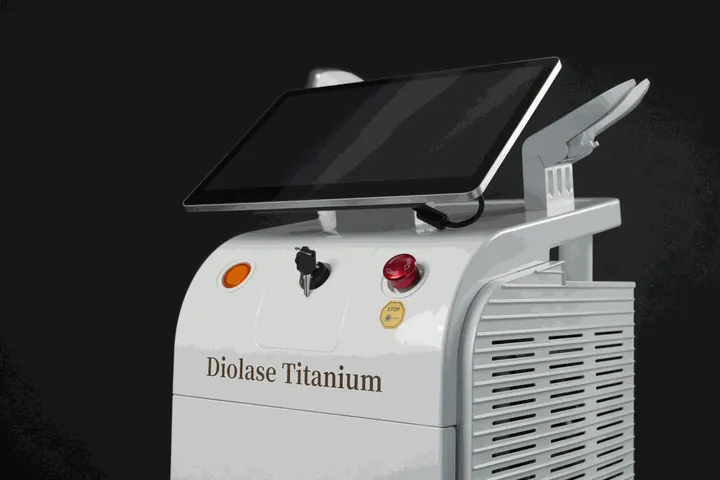
Two aesthetic systems can look similar, use similar displays, offer the same wavelength categories and make similar treatment claims without being configured the same way underneath.
What you’re actually purchasing is an integrated hardware system: its power architecture, treatment area, pulse delivery, wavelength architecture, cooling, internal component selection, thermal management and serviceability, together with the training and technical support surrounding it.
When Pro 1 Laser configured DioLase Titanium, the objective wasn’t to build the smallest diode platform we could put our name on. It was to specify a professional system for clinics intending to make laser hair reduction a serious, high-volume service line.
DioLase Titanium is configured around an 1,800 W architecture, a 12 × 36 mm treatment window, -35°C ICE sapphire cooling and 755 / 808 / 1064 nm Quattro 4D™ technology.
We had the option to build smaller. We chose not to.
ATHENA Promotes -31°C Cooling. DioLase Is Configured to -35°C.
Cooling decides how a treatment feels, and how a treatment feels decides whether patients finish their course. ATHENA Super ICE markets contact cooling down to approximately -31°C, and that is a genuine feature. DioLase Titanium goes colder, with -35°C ICE sapphire contact cooling for virtually painless treatments.
What matters just as much is whether the cooling lasts. DioLase Titanium holds its cooling through back-to-back full-body sessions without overheating, so your providers never have to turn the energy down late in the day to keep patients comfortable. Protected skin means the follicle still gets the energy it needs.
Cold at startup is good. Cold all day, at full energy, is better.
Compare the complete platform: power, wavelength architecture, treatment area, pulse delivery, cooling and protocol.
45 Minutes vs 25–30 Minutes: Think Beyond the Treatment.
ATHENA Super ICE is promoted around approximately 45-minute full-body treatments. DioLase Titanium completes full-body sessions in approximately 25–30 minutes, depending on patient size, treatment area and technique.
Now put that into an eight-hour day. Shorter full-body appointments mean more bookings per room, more buffer between patients, and room to grow when full-body packages become your highest-volume service — or when several providers share the same platform.
A capital device shouldn’t be evaluated only by what it costs to purchase. It should also be evaluated by what it allows the treatment room to do.
If ATHENA Costs $39,995, Why Would I Buy DioLase Titanium?
That’s exactly the question you should ask, and it’s the reason we’ve created the ATHENA Competitive Match.
ATHENA Super ICE is currently advertised at $39,995 CAD. For eligible Canadian buyers, we’ll match that price on DioLase Titanium.
That means you do not have to decide whether DioLase is worth paying substantially more for. You can compare the hardware at the same acquisition price.
At that point, the comparison becomes straightforward. Both systems cover the same 755 / 808 / 1064 nm wavelength categories, while DioLase Titanium is configured with 1,800 W rather than 1,200 W, a 12 × 36 mm treatment window rather than 12 × 24 mm, 432 mm² rather than 288 mm² of treatment area, and -35°C ICE sapphire cooling rather than approximately -31°C cooling. DioLase also completes full-body sessions in approximately 25–30 minutes, compared with ATHENA’s approximately 45-minute published positioning.
If the price is the same, compare the machine.
DioLase Titanium — $39,995 CAD
ATHENA Competitive Match
Why Is DioLase Titanium’s MSRP $74,995?
DioLase Titanium’s manufacturer MSRP reflects how the platform is configured and positioned within the professional aesthetic-equipment market. The ATHENA Competitive Match is a specific competitive acquisition offer for qualified Canadian buyers comparing ATHENA Super ICE.
It does not mean the systems are configured identically, and it does not mean we downgraded DioLase Titanium to hit the price.
A qualifying Competitive Match purchase receives the DioLase configuration: the 1,800 W architecture, 12 × 36 mm handpiece, -35°C ICE sapphire cooling, 755 / 808 / 1064 nm Quattro 4D™ architecture, large-area workflow, precision treatment capability, and Pro 1 Laser training and onboarding support.
The point of the offer is simple. If ATHENA’s price is what brought you into the market, we don’t want price alone deciding which hardware you buy.
Specialized Hair Removal? We Agree.
There’s a valid argument in professional aesthetics that a device should be purpose-built for the service it’s expected to perform. We agree.
DioLase Titanium is a dedicated professional diode hair-reduction platform. Versatility does not have to mean stuffing unrelated technologies into one cabinet. Within hair reduction, versatility can mean having the architecture to address different treatment areas, follicle depths, skin types and workflow requirements while remaining focused on one core category.
DioLase Titanium’s Quattro 4D™ configuration combines 755, 808 and 1064 nm, with 808 nm remaining central to the platform.
Our position is simple: buy a specialized hair-reduction system. Just don’t confuse specialization with a smaller hardware configuration.
Before You Buy ATHENA Super ICE, Know What to Ask.
Whether you purchase ATHENA, DioLase or another professional diode platform, ask the supplier to show you exactly what you’re buying.
Hardware and Energy Delivery
Confirm the rated power of the exact unit you will receive, not the manufacturer’s highest available model. Ask for the treatment-window dimensions, installed wavelengths, pulse-duration range and sustained repetition rates. Ask how those wavelengths are generated and delivered, and make sure the answers apply to the exact configuration being quoted to your clinic.
Cooling, Reliability and Service
Ask how the cooling system performs during extended operation, not just at startup. Confirm what the handpiece warranty covers, how long that coverage lasts, what a replacement handpiece costs, where service is performed, who performs it and how quickly replacement parts can be obtained. Downtime is part of total ownership cost.
Our answers: DioLase Titanium holds its -35°C cooling through back-to-back full-body sessions, the handpiece is rated for 100 million+ pulses with a $7,500 replacement, and every new system carries an 18-month warranty.
Training and Technical Support
Find out exactly what clinical training is included and whether it is online, hands-on, on-site or ongoing. Ask who you call after the sale, what technical support is included and what happens when a clinical or technical question comes up months after installation.
Financing, Regulatory Status and Workflow
Compare total equipment cost rather than only the monthly payment. Ask what regulatory authorization applies to the exact model being sold, and request the relevant licence or clearance. Finally, ask how much time you should realistically schedule for a full-body appointment so you can model the treatment-room economics using a real operating assumption rather than a headline claim.
Don’t just compare machines. Compare ownership.
Compare the Economics Yourself.
The fastest way to see what DioLase Titanium can earn is to model it with your own numbers.
Use the DioLase Titanium revenue calculator to build the service line from your average treatment price, treatments per day, working days per week and utilization. Then set that revenue against a $39,995 Competitive Match acquisition price, or a lease-to-own payment from $599/month (OAC).
Your assumptions. Your numbers. Your decision.
Calculate DioLase Revenue Potential
ATHENA Super ICE Price vs DioLase Titanium Price
ATHENA Super ICE is currently advertised at approximately $39,995 CAD. DioLase Titanium’s manufacturer MSRP is $74,995 CAD.
Through the current ATHENA Competitive Match program, eligible Canadian buyers considering ATHENA Super ICE can purchase a qualifying DioLase Titanium configuration for $39,995 CAD. That allows buyers to compare the two systems without letting acquisition price alone decide the purchase.
ATHENA Super ICE — current advertised price$39,995 CAD
DioLase Titanium — manufacturer MSRP$74,995 CAD
ATHENA Competitive Match$39,995 CAD
Competitor pricing is subject to change. Competitive Match offer applies to eligible purchases and may not be combined with certain promotions. Financing subject to approval. Contact Laser Equipment Global for current terms.
Before You Buy ATHENA Super ICE, See DioLase Titanium.
If you’re already searching for ATHENA Super ICE, you’ve probably moved beyond the question of whether professional laser hair reduction belongs in your clinic. You’re deciding which system deserves the treatment room.
Both systems cover the same core 755 / 808 / 1064 nm wavelength categories. The decision now comes down to the configuration, the workflow, the support, the ownership experience and the economics.
We’ve made the price comparison simple, too. For eligible Canadian buyers, DioLase Titanium is available through the ATHENA Competitive Match at the same $39,995 CAD acquisition price.
Compare the hardware. Compare the workflow. Compare the support. Compare the economics. Then choose the platform you want to work with for the next several years.
DioLase Titanium
Built for clinics that intend to stay busy.
Claim the $39,995 ATHENA MatchBook a DioLase DemoRun the ROI Calculator
Final Offer Terms
ATHENA Competitive Match — $39,995 CAD. Available to eligible Canadian buyers purchasing a qualifying DioLase Titanium configuration. Competitor pricing must be current and verifiable. Offer is subject to availability and change and may not be combined with certain promotions or discounts. Financing is subject to lender approval. Manufacturer MSRP is a suggested retail price and is not represented as a previous selling price. Treatment times, patient comfort and clinical results vary according to patient characteristics, protocol, treatment area, provider technique and other factors.
Related devices
FAQs
What is ATHENA Super ICE?
ATHENA Super ICE is a professional diode laser platform marketed for laser hair reduction. It is promoted with triple-wavelength 755 / 808 / 1064 nm technology, contact cooling and large-area treatment capability.
What wavelengths does ATHENA Super ICE use?
ATHENA Super ICE is marketed as a triple-wavelength diode platform using 755 nm, 808 nm and 1064 nm. DioLase Titanium Quattro 4D™ also uses 755 / 808 / 1064 nm. For that reason, wavelength count alone is not the primary difference between the two systems.
Is a 755 nm diode laser the same as an Alexandrite laser?
No. A diode system operating around 755 nm is not an Alexandrite solid-state laser. The wavelength region is similar, but the underlying laser source and delivery architecture are different.
Is a 1064 nm diode channel the same as an Nd:YAG laser?
No. A diode system producing energy around 1064 nm is not an Nd:YAG laser. Nd:YAG refers to a specific solid-state laser medium and architecture.
What is the ATHENA Super ICE treatment-window size?
ATHENA Super ICE is advertised with a 12 × 24 mm treatment window, which equals approximately 288 mm² of treatment area.
What is the DioLase Titanium treatment-window size?
DioLase Titanium uses a 12 × 36 mm large-area treatment window, which equals approximately 432 mm² of treatment area. DioLase Titanium also includes a detachable precision tip for smaller treatment areas.
How much larger is the DioLase Titanium treatment window?
A 12 × 36 mm window provides 432 mm² of treatment area compared with 288 mm² for a 12 × 24 mm window. That makes the DioLase Titanium treatment window 50% larger by area — more skin covered with every placement, and fewer placements across legs, backs and full-body appointments.
Is an 1,800 W diode laser automatically better than a 1,200 W diode laser?
Power is not the only specification that matters, but in a high-volume hair-removal room it is one of the most important. A large 12 × 36 mm window needs real power behind it to stay fast through legs, backs and full-body appointments. DioLase Titanium pairs that window with 1,800 W; ATHENA Super ICE pairs a smaller 12 × 24 mm window with 1,200 W.
How cold does ATHENA Super ICE get?
ATHENA Super ICE is currently marketed with contact cooling down to approximately -31°C.
How cold does DioLase Titanium get?
DioLase Titanium uses -35°C ICE sapphire contact cooling for virtually painless treatments, and it holds that cooling through back-to-back full-body sessions without overheating — so providers never have to turn energy down to keep patients comfortable.
How long does an ATHENA Super ICE full-body treatment take?
ATHENA Super ICE is marketed around approximately 45-minute full-body treatments.
How long does a DioLase Titanium full-body treatment take?
Approximately 25–30 minutes, depending on patient size, treatment area and provider technique — against the approximately 45 minutes ATHENA Super ICE publishes for the same appointment.
How much does ATHENA Super ICE cost?
ATHENA Super ICE is currently advertised in Canada at approximately $39,995 CAD — the same price eligible Canadian buyers can pay for DioLase Titanium through the ATHENA Competitive Match.
How much does DioLase Titanium cost?
DioLase Titanium has a manufacturer MSRP of $74,995 CAD. Eligible Canadian buyers comparing ATHENA Super ICE qualify for the $39,995 CAD ATHENA Competitive Match, and lease-to-own starts from $599/month (OAC). Contact Laser Equipment Global to confirm eligibility and lock in the offer.
Does Laser Equipment Global price-match ATHENA Super ICE?
For eligible Canadian purchases, Laser Equipment Global currently offers an ATHENA Competitive Match of $39,995 CAD on qualifying DioLase Titanium configurations, subject to current competitor pricing and offer terms.
Is ATHENA Super ICE or DioLase Titanium better?
For a clinic building a high-volume hair-removal service, DioLase Titanium. Both use 755 / 808 / 1064 nm, so wavelengths are a tie. DioLase Titanium then brings 1,800 W, a 12 × 36 mm window with 432 mm² of treatment area, -35°C ICE sapphire cooling and approximately 25–30-minute full-body sessions, against ATHENA Super ICE's 12 × 24 mm window, approximately -31°C cooling and approximately 45-minute full-body positioning. Add clinical training, an 18-month warranty and the $39,995 CAD Competitive Match, and you get the larger configuration for the same acquisition price.
Explore the technology
Product names and trademarks are the property of their respective owners. Laser Equipment Global is not affiliated with, or endorsed by, ATHENA Super ICE. This comparison is provided for identification and evaluation purposes only.