Buying guide
The scanner is the laser: how to compare fractional CO₂ platforms
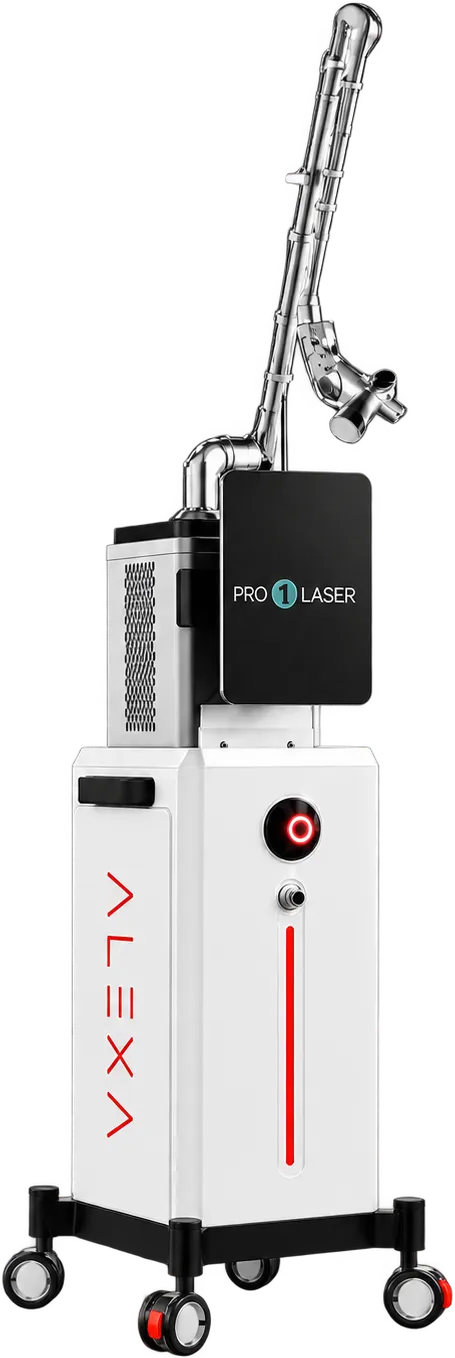
Every CO₂ laser emits at the same wavelength, 10,600 nm. So when two platforms are priced very differently, the difference is rarely the light itself. It is how that light is delivered: the scanner, the power behind it, and how much control the clinician has over each pass. Here is how to read the spec.
What makes one fractional CO₂ laser better than another?
Every CO₂ laser emits at 10,600 nm, so the difference is in delivery: the scanner, the power behind it, and how much control the clinician has over each pass. Compare power, dwell time, density and pattern, and favour a scanner that lets you vary depth and density independently, area by area.
Four settings that shape every treatment
| Setting | What it controls | Why it matters clinically |
|---|---|---|
| Power | Energy delivered per pulse | Sets how deep each microscopic column reaches |
| Dwell / pulse time | How long energy is delivered per spot | Balances ablation against thermal effect in surrounding tissue |
| Density | How much of the skin surface is treated | Higher density treats more tissue and heals more slowly; lower density heals faster |
| Pattern and area | Shape and size of the scanned field | Affects coverage speed, edge blending and how well the handpiece fits the anatomy |
Depth and density pull in opposite directions, so a scanner that lets you vary them independently, area by area, is what makes protocols repeatable.
Why scanner control matters
A face is not uniform. The periorbital area, the cheeks, the neck and a scarred area each want different settings. A platform with limited scanner options forces one compromise across them all. One with a wide adjustment range lets a trained clinician treat each zone appropriately, and lets a clinic build separate protocols for resurfacing, scar revision and texture.
Pattern also matters for comfort and safety. How the scanner places successive spots affects how heat accumulates in the tissue. Ask how the device sequences its pulses, and whether the clinician can change it.
Power headroom
More available power does not mean every treatment runs hotter. It means the device can reach the depth a protocol needs at a practical speed, without being run at its limit all day. Compare maximum power as a ceiling, then ask what clinicians actually use for the indications you plan to offer.
Questions to ask any CO₂ vendor
- What power options are available, and what does each cost?
- What is the maximum scan area, and can pattern, size and density be adjusted per treatment?
- How are pulses sequenced across the field?
- Which indications are covered in the approved labelling?
- What does training cover, and who supports the clinic afterwards?
- What are the warranty terms, and who services the device in Canada?
Alexa CO₂ at a glance
- 10,600 nm CO₂ with articulated-arm beam delivery
- 40 W (Alexa Aesthetic) or 60 W (Alexa Pro MVP 7)
- Fractional scanning up to a 30 mm treatment area
- Indicated for acne and surgical scar revision, fractional and ablative resurfacing, and benign lesion removal
- Alexa Femme™ women’s-health protocols available as a separate service line
- Clinical training, onboarding and ongoing support, an 18-month warranty and free standard shipping within Canada
- Health Canada licensed (MDL 114909), sold manufacturer-direct
- Lease-to-own from $799/month OAC
Bring this list to any CO₂ vendor, including us. Book a demo or request pricing. For acne-scar protocols, read Fractional CO₂ for acne scars, and for the ablative-versus-fractional distinction, Ablative or fractional? The CO₂ distinction.
Indications and regulatory availability may vary by jurisdiction. Results vary with patient selection, provider training and protocol. Financing is on approved credit.
Keep reading
Considering a platform for your clinic? Request pricing or book a demo.