Buying guide
Picosecond laser for pigmented lesions: building a pigment-correction service your clinic can sell
A picosecond laser fragments pigment with pulses about a thousand times shorter than nanosecond lasers, with less heat spread. 532 nm suits superficial pigment and 1064 nm deeper pigment and darker skin, so clinics sell sun-spot correction as a planned course.
Sun spots, freckles and uneven tone bring patients into a clinic who would never book a tattoo removal. They are motivated, they can see the problem in the mirror, and once the spots fade they tend to stay for the skin-quality work that follows. For a clinic owner, pigment correction is one of the most dependable new-patient services a picosecond laser can run. Here is how the technology works on pigment, which wavelength does which job, and how to build the service around it.
Can a picosecond laser treat sun spots and other pigmented lesions?
Yes. Picosecond lasers are widely used for solar lentigines (sun spots), freckling, uneven tone and selected benign pigment concerns. The ultra-short pulse breaks pigment into fine particles the body can clear, with less heat spread into surrounding skin. Wavelength is matched to pigment depth, and results build over a course. Melasma follows its own, more conservative logic.
Why the pulse length matters
A picosecond laser delivers energy in pulses measured in trillionths of a second, roughly a thousand times shorter than a Q-switched nanosecond laser. At that speed, pigment is fragmented largely by a photoacoustic effect, a rapid pressure wave, rather than by heat. The result is finer fragments with a smaller thermal component, which is the property clinics want around pigment-reactive skin. The picosecond vs Q-switched comparison covers the physics in full.
The evidence for this category is solid. A 2025 systematic review of 41 clinical trials in solar lentigines, covering 3,234 patients, reported success rates of 67.9% to 93.02% for picosecond lasers, against 36.36% to 76.6% for Q-switched lasers, and concluded that laser therapy appears more effective than other modalities, while calling for larger randomized trials (Mardani et al., Journal of Cosmetic Dermatology, 2025).
Be honest with yourself about what that does and does not prove. In a randomized split-lesion study of 532 nm lasers on solar lentigines in Asian patients, picosecond and Q-switched nanosecond treatment produced no significant difference in pigment clearance, with adverse events and pain also no different. Patient satisfaction, however, was significantly higher with the picosecond laser (Vachiramon et al., Lasers in Medical Science, 2018). A Q-switched laser can clear a sun spot. The case for picosecond is the whole pigment menu, the satisfaction of the patients in your chair, and everything else the platform does.
Which wavelength for which pigment
Pulse duration decides how energy behaves once absorbed. Wavelength decides what absorbs it, and how deep.
| Pigment presentation | Typical wavelength | Why |
|---|---|---|
| Superficial, epidermal pigment (sun spots, freckling) | 532 nm | Strongly absorbed by melanin near the surface |
| Deeper or dermal pigment | 1064 nm | Penetrates deeper; absorbed less by epidermal melanin |
| Pigment-prone or darker skin | 1064 nm as the foundation | Spares more epidermal melanin; 532 nm used selectively |
| Melasma-focused planning | 1064 nm | Published randomized melasma evidence anchors on 1064 nm picosecond |
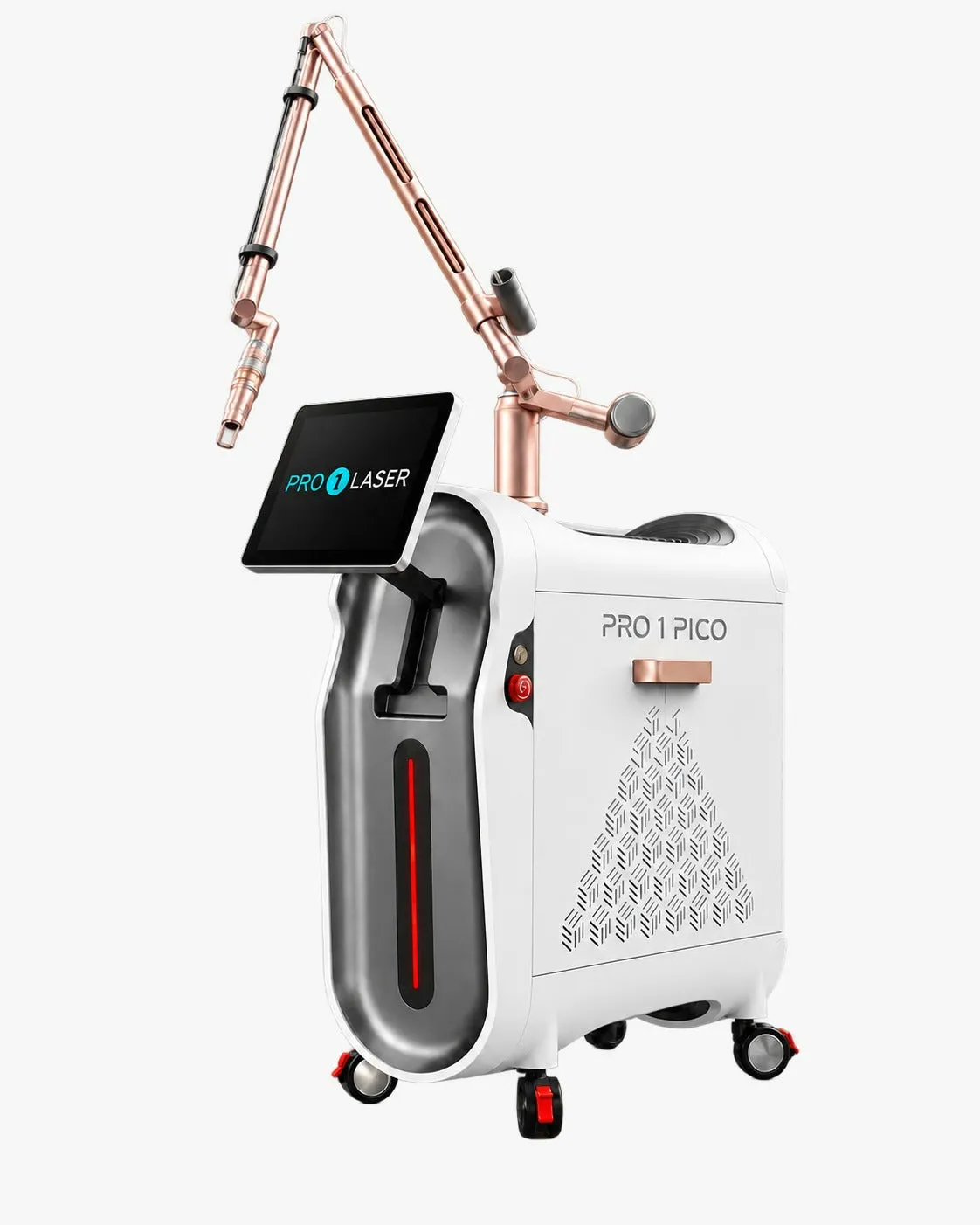
Pro 1 Pico delivers both 1064 nm and 532 nm at 500 ps from one platform, so wavelength becomes a treatment decision rather than a second purchase. Its optional 585 nm and 650 nm handpieces are for resistant blue and green tattoo inks. The 1064 nm vs 532 nm guide explains the trade-off lesion by lesion.
Darker skin types need a conservative plan
The same melanin that makes a sun spot a target also sits in the surrounding skin. The more baseline melanin a patient has, the more the epidermis competes for energy, and the more post-inflammatory hyperpigmentation (PIH) becomes the risk to plan around.
The data show both the opportunity and the caution. In a prospective study of 20 patients with Fitzpatrick type III and IV skin treated for facial lentigines with a 532 nm picosecond laser, 18 patients (90%) achieved moderate to significant improvement at 12 weeks. PIH still occurred in 14 of 137 sessions (10.2%) (Chan et al., Lasers in Surgery and Medicine, 2019).
That is why pigment-prone skin is usually planned on a 1064 nm foundation, with 532 nm applied selectively and every decision left to a trained provider. Pro 1 Pico is used across Fitzpatrick I–VI with appropriate parameters by a trained provider, and its PTP dual-pulse delivery splits each pulse into a controlled pair for more control on delicate areas. The PTP explainer shows how that works.
Some pigment is less predictable
Not every brown mark behaves like a sun spot. Café-au-lait-type macules respond variably. In a retrospective study of 116 patients treated with 1064 nm lasers, picosecond and nanosecond treatment showed no statistically significant difference in efficacy; complications were numerically lower with picosecond (16.9% vs 24.2%), but that difference was not significant either (Wang et al., Lasers in Medical Science, 2025). Sell these cases on careful assessment and realistic expectations, not on clearance.
Melasma sits further along the same line. It is recurrence-prone, reactive and never a one-treatment promise. Our Pro 1 Pico for melasma guide covers the 1064 nm-first approach and the evidence behind it.
How to package pigment correction
Pigment correction sells best as a structured service, not a per-spot price list.
- Consultation and assessment. Identify the pigment type, depth and distribution, and the patient’s skin type. A few discrete lentigines and a full face of uneven tone are different problems, and anything with an uncertain diagnosis is assessed before it is treated.
- Test spot. In pigment-prone skin, a test area before the full treatment lets the provider see how the skin responds and builds patient confidence.
- A planned course. Price the course, not the visit. Results build over sessions and vary with lesion, skin type and protocol.
- Standardized photo tracking. Same lighting, same angles, every visit. Photos keep patients committed through a course and support the conversation about what comes next.
- Maintenance with PicoFusion™. A pigment series ends when the spots fade. PicoFusion™, Pro 1 Pico’s pulse-stacking mode for collagen banking and skin quality, is non-ablative and fits a lunch-hour schedule, so the patient moves into a recurring maintenance plan instead of leaving.
Pigment work often leads into broader skin quality. On the same platform, PicoMatrix™ adds targeted remodeling for texture, pores and acne scars, and long-pulse 1064 nm addresses redness and visible vessels. The patient who came for sun spots has somewhere to go next. The pigmentation application page shows how the pigment menu fits together, and the four energy behaviours post shows the full platform.
What to ask any vendor
- What is the documented pulse duration at each wavelength? “Picosecond” is a domain, not a specification.
- Are both 1064 nm and 532 nm included? Superficial and deeper pigment need different tools.
- How does the system support darker skin types? Ask about the wavelength foundation and delivery control, not just the brochure claim.
- Is there a maintenance mode? A pigment-only device stops earning when the course ends.
- Are there per-pulse consumables? They compound across every session.
- What does training cover? Pigment assessment, test-spot practice and skin-type planning should be in the curriculum, not only tattoo removal.
- What are the warranty, service and financing terms in writing?
The picosecond laser buying guide works through each question in detail.
Pro 1 Pico for pigment correction
Pro 1 Pico is built for clinics that want pigment correction to open the door to a full skin-quality menu.
- True 500 ps picosecond delivery at 1064 nm and 532 nm, with PTP dual-pulse energy up to 1600 mJ
- Optional 585 nm and 650 nm handpieces for resistant blue and green tattoo inks
- PicoFusion™ for collagen banking and maintenance, PicoMatrix™ for remodeling, long-pulse 1064 nm for redness and veins
- Used across Fitzpatrick I–VI with appropriate parameters by a trained provider
- No per-pulse consumables
- Onboarding, clinical training and protocol guidance, plus an 18-month warranty
- Health Canada licensed (MDL 114765) and FDA cleared, sold manufacturer-direct
- Lease-to-own from $999/month OAC
See how pigment correction fits your treatment menu. Book a demo or request Pro 1 Pico pricing.
Clinical results vary with patient selection, provider training and protocol. Indications and regulatory availability may vary by jurisdiction. Financing is on approved credit.
FAQs
Which pigmented lesions can a picosecond laser treat?
Clinics commonly use picosecond lasers for sun spots and solar lentigines, freckling, uneven tone and selected benign pigment concerns assessed by the provider. Melasma is planned separately because it is recurrence-prone and reactive. Any lesion with an uncertain diagnosis should be assessed before laser treatment.
Is 532 nm or 1064 nm better for sun spots?
They do different jobs. 532 nm is strongly absorbed by melanin near the surface, which suits superficial, epidermal pigment. 1064 nm penetrates deeper and is absorbed less by epidermal melanin, which suits deeper pigment and pigment-prone or darker skin. A dual-wavelength platform lets the provider choose per lesion.
Is a picosecond laser better than a Q-switched laser for lentigines?
Both are effective. In a randomized split-lesion study of 532 nm lasers on solar lentigines, pigment clearance did not differ significantly between picosecond and Q-switched nanosecond treatment, but patient satisfaction was significantly higher with the picosecond laser. The picosecond case is stronger across a broader menu than on lentigines alone.
Can picosecond lasers be used on darker skin for pigment?
Yes, with conservative planning. 1064 nm is the usual foundation because epidermal melanin absorbs it less, and 532 nm is applied more selectively as baseline melanin rises. Post-inflammatory hyperpigmentation can still occur, so test spots, gradual courses and provider judgment matter.
How many sessions does pigment correction take?
It varies with lesion type, depth, skin type and protocol. Discrete sun spots may respond within a short course, while café-au-lait-type pigment and melasma are less predictable and can recur. Set expectations at consultation and track progress with standardized photos.
Keep reading
Considering a platform for your clinic? Request pricing or book a demo.