Clinic operations
The CO₂ recovery timeline your patients should hear before they book
After fractional CO₂, redness, swelling and peeling typically settle within days to about a week; fully ablative resurfacing takes roughly two weeks to heal, with pinkness that can last months. Results build for months as collagen remodels.
CO₂ resurfacing produces some of the most visible results on an aesthetic menu, and some of the most visible recoveries. The clinics that build a strong CO₂ service line are not the ones whose patients heal fastest. They are the ones whose patients knew, day by day, what healing would look like before they booked.
How long does recovery take after CO₂ laser resurfacing?
It depends on depth and density. After lighter fractional treatment, redness typically settles within a few days; deeper fractional work often takes about a week. Classic fully ablative resurfacing takes roughly two weeks to heal, and pinkness can last months. In every case, the visible result keeps developing for months as collagen remodels.
Why the timeline is a business tool
Patients rarely leave a CO₂ course because healing went wrong. They leave because healing looked different from what they expected. Redness on day five, peeling skin before a weekend event, or pinkness at week six all feel like problems to someone who was told “a few days of downtime”. To someone who was shown the timeline at consultation, they are milestones.
That difference shows up in three places a clinic owner cares about: fewer anxious calls and unscheduled visits, more patients returning for their second and third sessions, and reviews that describe the experience as well managed rather than alarming.
The recovery timeline, by intensity
Recovery tracks the CO₂ resurfacing intensity ladder: lighter, lower-density fractional work heals fastest, and fully ablative resurfacing takes longest. The ranges below are typical, not promises. Treatment area, skin type, the patient’s healing and the provider’s plan all shift them.
| Window | Lighter fractional | Deeper fractional | Fully ablative |
|---|---|---|---|
| Days 0–2 | Redness and mild swelling | More swelling, with oozing and light crusting | Open healing surface; the most swelling and the most aftercare |
| Days 3–7 | Light flaking; redness typically settled within a few days | Crusting clears; redness and swelling often settle by about a week | Skin still resurfacing |
| Weeks 2–4 | Usually back to normal routine | Usually back to normal routine once cleared | New skin typically in place by roughly two weeks; pinkness remains |
| Months 1–6 | Gradual improvement across the course | Continued remodelling; results build between sessions | Pinkness fading over months; results continue to mature |
The published evidence fits this shape. In a prospective study of fractional CO₂ on the lower eyelids, patients reported crusting and oozing that resolved within 48 to 72 hours, and moderate redness and swelling that resolved by the one-week visit, with improvement measured at six months (Tierney et al., Journal of the American Academy of Dermatology, 2011). Fully ablative work is a different conversation: in a series of 500 patients resurfaced with a pulsed and scanned CO₂ laser, post-treatment redness occurred in every patient and lasted an average of 4.5 months (Nanni and Alster, Dermatologic Surgery, 1998).
For more on why the two modes heal so differently, see Ablative or fractional? The CO₂ distinction.
When results develop
Patients notice smoother, brighter skin as soon as peeling finishes, and many assume that is the result. It is the start of it. The first in-vivo human study of ablative fractional CO₂ found a collagen remodelling response that persisted for at least three months after treatment (Hantash et al., Lasers in Surgery and Medicine, 2007). Tell patients that the real comparison is their month-three or month-six photo against their baseline, not the mirror at week two. For the biology behind that delay, see how fractional CO₂ builds collagen.
Makeup, sun and normal routine
Patients will ask two questions before almost any other: when can I wear makeup, and when can I be in the sun? Give them a rule tied to healing rather than a calendar date: makeup typically returns once crusting and peeling have finished and the provider has confirmed the skin has resurfaced, which is earlier after light fractional work and later after ablative resurfacing. Sun avoidance and protection start immediately and continue for months, because freshly resurfaced skin is prone to pigment change. In the 500-patient ablative series, hyperpigmentation occurred in 37% of patients, at a higher rate in darker skin phototypes.
Setting expectations at consultation
The consultation is where the recovery is really managed. A few habits make the difference:
- Show the timeline, not just the result. Before-and-after photos sell the outcome. A day-by-day recovery sequence sells the decision. If your clinic has consented healing photos, use them.
- Match the rung to the calendar. Ask about weddings, travel, work presentations and outdoor plans in the next month. A patient with no time off may suit a lighter fractional plan over more sessions; a patient who wants a single corrective procedure needs to plan roughly two weeks around it.
- Name the normal stages. Redness, swelling, crusting, peeling, and a period of looking worse before looking better. Patients who hear these in advance rarely call about them.
- Explain the course. Fractional resurfacing is usually planned as a series, and results build between sessions. Book the follow-up visits and photo appointments at the first visit.
- Be candid about skin type. Ablative CO₂ is generally planned most conservatively as melanin content rises, and pigment change is the risk patients with darker skin most need to understand.
What to put in the patient handout
A good handout is short, specific to the treatment the patient actually had, and written for someone tired and slightly worried at home on day two. Keep product instructions to whatever your clinic’s protocol specifies, and spend the space on:
- The patient’s own timeline. Lighter fractional, deeper fractional or ablative, with what is normal on days 1–2, days 3–7 and weeks 2–4.
- What not to do. No picking or peeling flakes, no sun exposure, no new skincare or treatments until cleared.
- When makeup and normal activities may resume, tied to healing milestones and provider sign-off.
- Follow-up dates, including the next session and the photo appointment.
- Warning signs and a named contact, with a phone number answered outside clinic hours.
When to escalate: signs that need clinician review
Serious complications after resurfacing are uncommon, but patients need to know what is not normal. Fractional resurfacing carries a much lower overall complication rate than traditional ablative techniques, yet serious complications can still develop, more often in sensitive areas and in darker phototypes, and many are preventable (Metelitsa and Alster, Dermatologic Surgery, 2010). In the ablative series above, herpes simplex reactivation occurred in 7.4% of patients regardless of prior history, and acne flares, milia and dermatitis in 10–15%.
Ask patients to call the clinic, not wait for their next visit, if they notice:
- Pain, swelling or redness that worsens after the first two days instead of settling
- Pus, honey-coloured or yellow crusting, a bad smell, or fever
- Clustered blisters, sores or stinging that may signal a cold-sore flare
- Skin that stays raw or weeping beyond the window their plan predicted
- New darkening, lightening, or firm raised areas as the skin heals
Early review of these signs is part of what keeps an uncommon complication from becoming a lasting one.
The payoff: satisfaction, reviews and completed courses
A clear recovery plan is one of the cheapest retention tools in the clinic. Patients who were prepared describe their downtime as “exactly what they said”, which is the sentence you want in a review. They also return for session two, which is where fractional CO₂ economics work: as our guide to building an acne-scar service line with fractional CO₂ sets out, the course, not the single visit, is the product.
Training matters here too. Expectation-setting, tier selection across skin types and aftercare protocol are part of a good CO₂ onboarding; the Alexa CO₂ getting-started guide describes a new owner’s first weeks.
Alexa CO₂ for a resurfacing menu with every recovery tier
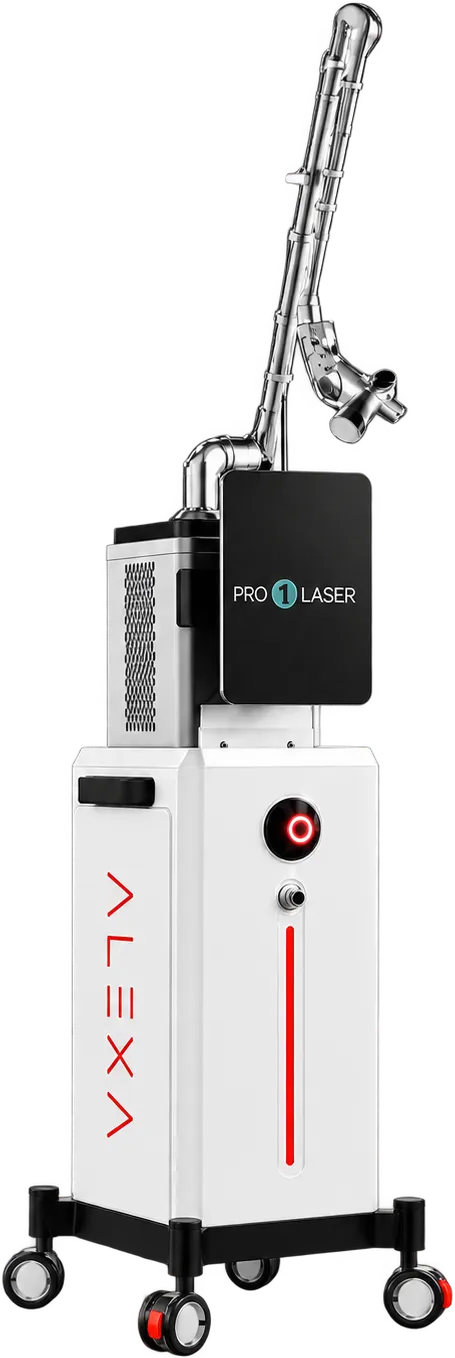
Alexa CO₂ Aesthetic lets one platform cover the whole ladder, so the recovery conversation is about the patient’s goals and calendar, not the limits of the device.
- 10,600 nm CO₂ with fractional and ablative capability and articulated-arm beam delivery
- 40 W (Alexa Aesthetic) or 60 W (Alexa Pro MVP 7)
- Fractional scanning up to a 30 mm treatment area, with customizable scan shapes
- Used for resurfacing, acne and surgical scar revision, and benign lesion work, with Alexa Femme™ and Alexa Follicle™ as separate service lines
- Onboarding, clinical training, protocol guidance and ongoing support, plus an 18-month warranty
- Health Canada licensed (MDL 114909)
- Lease-to-own from $799/month OAC
Build a CO₂ service line your patients finish. Book a demo or request pricing. For the full platform checklist, read the aesthetic CO₂ laser buying guide.
This article is general education for clinics and prospective buyers, not medical advice. Recovery and results vary with the individual, their skin type, the treatment plan and a trained provider’s assessment. Indications and regulatory availability may vary by jurisdiction. Financing is on approved credit.
FAQs
How long is recovery after fractional CO₂ resurfacing?
It depends on depth and density. Lighter fractional treatments may involve a few days of redness, and deeper fractional work about a week. In one prospective series, crusting and oozing resolved within 48 to 72 hours and redness and swelling by the one-week visit.
How long is recovery after fully ablative CO₂ resurfacing?
Classic full-field ablative resurfacing typically takes roughly two weeks before the skin has resurfaced, and pinkness can persist much longer. In a 1998 series of 500 patients, post-treatment redness occurred in everyone and lasted an average of 4.5 months.
When do CO₂ resurfacing results show?
Early smoothness often appears once peeling finishes, but the main change develops over months. Histology after ablative fractional CO₂ shows a collagen remodelling response lasting at least three months, so results are best assessed at follow-up months after treatment.
What signs after CO₂ resurfacing need clinician review?
Pain or redness that worsens instead of settling, pus, yellow crusting or fever, clustered blisters or sores that may signal a cold-sore flare, skin that stays raw beyond the expected window, and new dark, light or raised areas. Patients should know exactly who to call.
Keep reading
Considering a platform for your clinic? Request pricing or book a demo.