Clinical education
Why fractional CO₂ results keep improving for months: collagen remodelling for clinic owners
Fractional CO₂ creates microscopic columns of controlled injury that set off a wound-healing response, which keeps remodelling collagen for months after each session. Untreated skin between columns speeds recovery, so clinics sell texture work as a course.
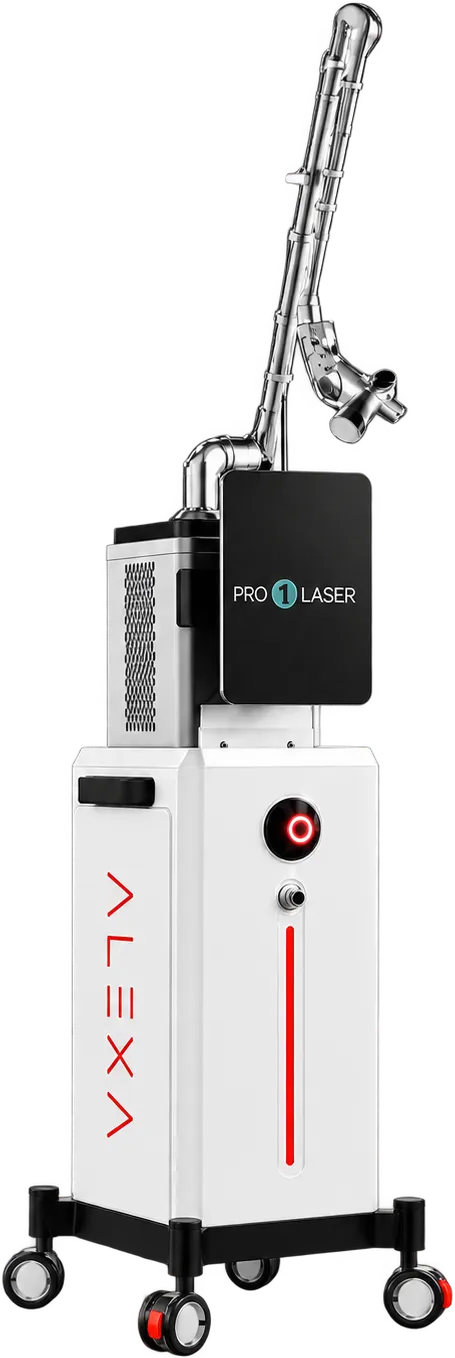
Patients ask for smoother skin, finer pores and fewer etched lines. What they are really buying is new collagen, and fractional CO₂ is one of the most dependable ways a clinic can deliver it. The biology also explains how to sell it: the result keeps building after the patient leaves the room. Here is the mechanism in plain terms, and what it means for the service you build around it.
How does fractional CO₂ stimulate collagen?
Fractional CO₂ ablates thousands of microscopic columns into the skin, each surrounded by a thin zone of heat, while leaving the skin between them intact. Each column sets off a wound-healing response: inflammation, then new tissue formation, then months of collagen remodelling. The intact bridges speed recovery, and the dermis keeps rebuilding long after the surface has healed.
From one microscopic wound to new collagen
The idea of treating skin in a pattern of tiny zones, rather than all at once, was introduced in 2004 as fractional photothermolysis. That first study used a non-ablative prototype, and it showed that skin tolerates an array of microscopic treatment zones well, with the surface re-epithelialized within a day and measurable wrinkle improvement three months after treatment (Manstein et al., Lasers in Surgery and Medicine, 2004).
A CO₂ laser at 10,600 nm takes the concept further. Its energy is strongly absorbed by water in tissue, so each microbeam vaporizes a narrow column and leaves a collar of thermal coagulation around it. The first in-vivo human study of ablative fractional CO₂ described exactly that structure: tapering columns of ablation surrounded by coagulated tissue (Hantash et al., Lasers in Surgery and Medicine, 2007).
What happens next is the skin’s ordinary repair sequence, run thousands of times across the treated area:
| Phase | What the skin is doing | What the patient notices |
|---|---|---|
| Inflammation | Signals the injury, clears damaged tissue, recruits repair cells | Redness, swelling, a sunburn-like feel |
| Proliferation | Closes the surface and lays down new matrix in the dermis | Peeling and flaking as the surface renews |
| Remodelling | Reorganizes and strengthens new collagen over months | Gradual change in texture, tone and fine lines |
The study evidence tracks that timeline. In the Hantash study, a stress-response marker appeared within two days and had largely faded by three months, while hsp47, a marker the authors linked to collagen remodelling, appeared at one week and was still elevated at three months. The authors described a persistent collagen remodelling response lasting at least three months. A separate study of fractional CO₂ on photodamaged facial and neck skin found consistent up-regulation of the matrix metalloproteinases (MMPs), enzymes that remodel the dermal matrix, the same enzymes previously reported after fully ablative resurfacing (Reilly et al., Archives of Facial Plastic Surgery, 2010). The authors concluded that fractional and fully ablative CO₂ appear to work through similar molecular mechanisms.
Why fractional heals faster than full-field resurfacing
If the repair biology is similar, why is recovery so different? The answer is the intact skin between the columns.
Fully ablative resurfacing removes the surface as a continuous sheet, so healing has to cover the whole area. Fractional delivery treats a patterned fraction of it. The untouched bridges between microscopic zones hold healthy cells right beside every wound, so each column closes over from close range. The full distinction is set out in ablative or fractional? The CO₂ distinction.
The trade-off is well described in the literature. A major review of laser resurfacing places fractional between the two other approaches: more effective than non-ablative treatment, with faster recovery than full-field ablation. It also notes that full-field ablative resurfacing, with its roughly two-week recovery, still produces the results the others are measured against (Alexiades-Armenakas et al., Journal of the American Academy of Dermatology, 2008).
For a clinic, that is the business case for fractional in one sentence: a meaningful share of the correction with a recovery most patients can fit into their lives.
What the timeline means for your texture service
The biology sets the shape of the service. Three things follow from it.
Sell a course, not a session. Each treatment starts a remodelling cycle that runs for months, so texture work is planned as a series. Course length, spacing and settings come from clinical training and the device’s approved protocols, and they vary with the patient and the goal.
Set expectations early. Visible recovery runs from a few days to about two weeks depending on depth, while remodelling and visible improvement continue for months after the last visit. Our CO₂ recovery timeline guide breaks this down week by week for the consultation and the patient handout.
Use the intensity ladder. Depth and density decide where a treatment sits between light refresh and deep correction. The CO₂ resurfacing intensity ladder shows how clinics step patients up as their goals change. Ablative CO₂ is generally planned most conservatively as Fitzpatrick type rises, and patient selection, pre-care and post-care matter most there.
Combining fractional CO₂ with other services
Collagen remodelling is a long game, which makes fractional CO₂ a natural anchor for a broader skin-quality program rather than a stand-alone procedure.
- Maintenance between courses. Non-ablative treatments with less downtime per visit keep patients engaged between resurfacing courses. On the Pro 1 portfolio that layer runs on Pro 1 Pico (PicoMatrix™ and PicoFusion™) or DPL Elite. The collagen banking guide describes the maintenance approach.
- Scar programs. Acne and surgical scars use the same remodelling response with a different plan. See acne scars are a service line.
- Specialty lines on the same platform. On Alexa CO₂, Alexa Femme™ extends the platform into women’s health and Alexa Follicle™ into hair-restoration support, each with its own patient base.
The commercial logic is utilization. A patient who starts with a texture course and moves into maintenance is a relationship measured in years, not a single booking.
What to look for in a fractional CO₂ platform
Aesthetic CO₂ lasers emit at 10,600 nm, so the wavelength tells you nothing about which platform suits a remodelling program. Look at delivery instead:
- Fractional and ablative in one system. You want to move a patient up or down the ladder without changing devices.
- Scanner control. Customisable scan shapes and adjustable density decide how a pass behaves on a cheek versus the perioral area. Our guide on how to compare fractional CO₂ scanners goes deeper.
- Power for your menu. Light resurfacing needs less; deeper or higher-volume work benefits from a higher-power configuration.
- Training that covers tier selection and skin types. The biology rewards good planning; the training is where it comes from.
- Warranty, service and financing. A course of patients depends on uptime. Compare the full ownership terms, not the quote alone. The aesthetic CO₂ laser buying guide has the complete checklist.
Alexa CO₂ Aesthetic for texture and rejuvenation
Alexa CO₂ Aesthetic is built for clinics adding a corrective resurfacing tier above their maintenance treatments.
- 10,600 nm CO₂, fractional and ablative, with articulated-arm beam delivery
- 40 W (Alexa Aesthetic) or 60 W (Alexa Pro MVP 7)
- Fractional scanning up to a 30 mm treatment area, with customizable scan shapes on a touchscreen
- Alexa Femme™ and Alexa Follicle™ specialty pathways on the same platform
- Onboarding, clinical training, protocol guidance and ongoing support, plus an 18-month warranty and free standard shipping within Canada
- Health Canada licensed (MDL 114909), sold manufacturer-direct
- Lease-to-own from $799/month OAC
See how Alexa CO₂ fits a texture and rejuvenation program in your clinic. Book a demo or request pricing, and model the service line with the Alexa CO₂ revenue calculator. The full platform family is on the Alexa CO₂ page.
Clinical results vary with patient selection, provider training and protocol. Indications and regulatory availability may vary by jurisdiction. Financing is on approved credit.
FAQs
How does fractional CO₂ stimulate collagen?
Each microscopic column of ablation and surrounding heat triggers the skin's wound-healing response. Repair signals and collagen-building activity follow, and the dermis keeps remodelling for months. Histology from the first in-vivo study of ablative fractional CO₂ showed that response persisting for at least three months.
Why does fractional CO₂ heal faster than fully ablative resurfacing?
Only a fraction of the surface is treated. The intact skin between the microscopic zones acts as a reservoir for repair, so the surface closes over faster. Full-field ablative resurfacing still sets the benchmark for correction, but with a recovery of around two weeks.
When do patients see texture improvement after fractional CO₂?
Early smoothing appears once the surface has healed, but the collagen-driven change builds over the following months. Set that expectation at consultation and book review appointments accordingly. Results vary with patient selection, protocol and technique.
Can fractional CO₂ be combined with other skin treatments?
Yes. Many clinics use fractional CO₂ as the corrective tier of a skin-quality program, with lighter non-ablative treatments such as picosecond PicoMatrix™ or PicoFusion™ sessions, or DPL photorejuvenation, as the maintenance layer between resurfacing courses. The provider sets the sequence and timing.
Keep reading
Considering a platform for your clinic? Request pricing or book a demo.